

The Bhagavad Gita, one of the most revered Hindu texts, delves into the essence of our existence, the cosmos, and our connection with the divine. As a guiding light for life, it provides invaluable insights into our place in this vast universe. This sacred manuscript unfolds its teachings through a spiritual dialogue between Shri Krishna and his devoted disciple Arjuna, set amidst the backdrop of a momentous war. By convincing Arjuna to fulfill his duty on the battlefield, the Lord transforms his emotional turmoil into unwavering focus and righteous action. Written in the melodious language of Sanskrit, the Bhagavad Gita embraces an extensive vocabulary that masterfully conveys the spiritual concepts it elucidates. As the language through which the divine words were spoken, Sanskrit also finds its remarkable utility in the realm of computer languages, including ARTIFICIAL INTELLIGENCE.
At its core lies the science of knowing the absolute truth, Brahma Vidyā, a revelation that has captivated countless scholars, philosophers, eminent physicists, celebrities, and truth-seekers alike. Before this magnificent scripture, we all stand equal, humbled by its wisdom. Let us embark on this academic pursuit, offering insights through mathematical analysis, in the hope that it ignites your curiosity to unveil what countless others have already witnessed - our true selves. I sincerely urge you to take the next step and immerse yourself in the profound wisdom of the Bhagavad Gita by delving into its verses
Common Words
The Bhagavad Gita has 18 chapters, 700 verses and 4
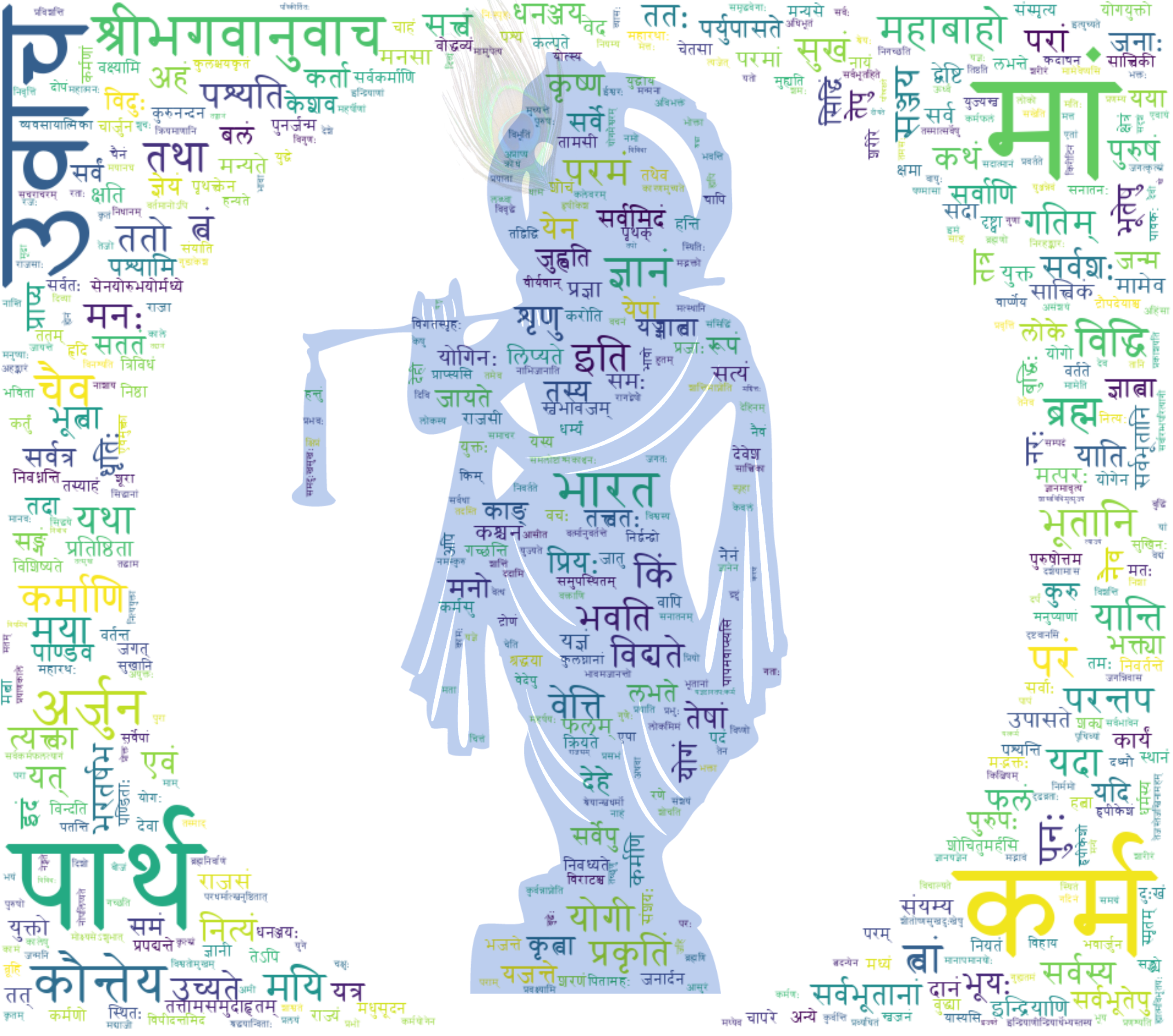
speakers. The images below summarizes the most frequently
occuring words in transliteration and Sanskrit.
Stop words like "the","and" or "is"... etc have been removed
before conducting text analysis and generating the word
cloud.
The top fifteen most popular words are:
‘मां’, ‘उवाच’, ‘पार्थ’, ‘कर्म’, ‘श्रीभगवानुवाच’, ‘कौन्तेय’, ‘अर्जुन’, ‘भारत’, ‘चैव’, ‘परं’, ‘तथा’, ‘ज्ञानं’, ‘त्वां’, ‘विद्धि’, ‘ब्रह्म’

Number of verses in each chapter
These chapters encompass profound teachings and spiritual wisdom, guiding individuals on the path of righteousness, self-realization, and devotion to the Supreme Divine. Each chapter presents unique insights and valuable lessons that resonate with seekers of truth and spiritual knowledge. For a more in-depth understanding of the content and themes of each chapter, you are encourage to explore firsthand.
-
Chapter 1:
Arjun Viṣhād Yog - Lamenting the Consequences of War
In the midst of the Battlefield of Kurukshetra, Arjuna, the valiant warrior, faces a moral crisis. Faced with the prospect of fighting his own family and teachers, Arjuna is overwhelmed by compassion and grief, setting the stage for the profound teachings that follow. -
Chapter 2: Sānkhya Yog - The Yog of Analytical Knowledge
As Arjuna seeks guidance from Lord Krishna, the Supreme Divine Personality, Krishna imparts the wisdom of analytical knowledge. He reveals the eternal nature of the soul, the impermanence of the body, and the path to selfless action, guiding Arjuna towards self-realization and the fulfillment of his duty. -
Chapter 3: Karm Yog - The Yog of Action
Shri Krishna emphasizes the importance of selfless action and duty, teaching Arjuna the path of Karm Yoga. Understanding the significance of performing one's prescribed duties without attachment to the outcomes, Arjuna learns the essence of righteous action and its connection to spiritual growth. -
Chapter 4: Jñāna Karm Sanyās Yog - The Yog of Knowledge and the
Disciplines of Action
Unraveling the mystery of divine knowledge, Shri Krishna reveals the ancient wisdom of the Bhagavad Gita, which has been passed down through the ages. He explains the concept of divine action, the importance of a realized teacher, and the significance of self-surrender in the pursuit of spiritual enlightenment. -
Chapter 5: Karm Sanyās Yog - The Yog of Renunciation
In this chapter, Shri Krishna elaborates on the concept of renunciation and the process of attaining liberation through the renunciation of selfish desires. He imparts the wisdom of selfless devotion and the path of Karm Sanyas Yoga, inspiring Arjuna to embrace detachment while fulfilling his duties as a warrior. -
Chapter 6: Dhyān Yog - The Yog of Meditation
Shri Krishna introduces the profound practice of meditation, leading Arjuna towards inner peace and self-realization. Explaining the process of Dhyana Yoga, Krishna elucidates the importance of focusing the mind and attaining union with the Divine through the art of meditation. -
Chapter 7: Jñāna Vijñāna Yog - Yog through the Realization of
Divine Knowledge
Revealing His divine glories, Shri Krishna expounds upon the true nature of the Supreme Being and the universe. He guides Arjuna towards understanding the essence of all beings and the path to divine knowledge, emphasizing the importance of unwavering devotion. -
Chapter 8: Akṣhar Brahma Yog - The Yog of the Eternal God
Shri Krishna expounds upon the eternal nature of the Supreme God and the journey of the soul after death. He reveals the process of departing from the mortal realm and attaining union with the eternal Brahman, providing insights into the spiritual realm beyond this material world. -
Chapter 9: Rāja Vidyā Yog - Yog through the King of Sciences
In this chapter, Shri Krishna imparts the knowledge of the most confidential truths to Arjuna, elucidating the principles of devotion, faith, and surrender. He reveals the essence of the supreme knowledge that empowers one to connect with the Divine in every aspect of life. -
Chapter 10: Vibhūti Yog - Yog through Appreciating the Infinite
Opulences of God
Shri Krishna describes His divine manifestations and opulences that are scattered throughout the universe. He demonstrates His infinite greatness and how all glorious and awe-inspiring manifestations are His divine expressions, enlightening Arjuna about the omnipresence of the Divine. -
Chapter 11: Viśhwarūp Darśhan Yog - Yog through Beholding the
Cosmic Form of God
In this pivotal chapter, Shri Krishna reveals His universal cosmic form to Arjuna, displaying the infinite aspects of existence and the interconnectedness of all beings. Beholding the awe-inspiring cosmic form of the Lord, Arjuna experiences a profound spiritual revelation. -
Chapter 12: Bhakti Yog - The Yog of Devotion
Shri Krishna extols the virtues of devotion and self-surrender, encouraging Arjuna to embrace the path of Bhakti Yoga. He emphasizes that genuine love and unwavering devotion to the Supreme is the most potent means to attain spiritual enlightenment and merge with the Divine. -
Chapter 13: Kṣhetra Kṣhetrajña Vibhāg Yog - Yog through
Distinguishing the Field and the Knower of the Field
Shri Krishna explains the distinction between the physical body (kshetra) and the eternal soul (kshetrajna). He imparts profound knowledge about the nature of the self, the importance of self-realizationand spiritual liberation. -
Chapter 14: Guṇa Traya Vibhāg Yog - Yog through Understanding the
Three Modes of Material Nature
Lord Krishna delves into the concept of the three modes of material nature - sattva (goodness), rajas (passion), and tamas (ignorance). He reveals how these modes influence human behavior and emotions and provides guidance on transcending them to attain spiritual growth and liberation. -
Chapter 15: Puruṣhottam Yog - The Yog of the Supreme Divine
Personality
In this chapter, Lord Krishna elucidates the eternal and imperishable nature of the Supreme Being, the ultimate reality behind all existence. He expounds on the significance of surrendering to the Divine and attaining divine knowledge to attain liberation and freedom from the cycle of birth and death. -
Chapter 16: Daivāsura Sampad Vibhāg Yog - Yog through Discerning
the Divine and Demoniac Natures
Lord Krishna discusses the characteristics of divine and demoniac qualities in individuals. He emphasizes the importance of cultivating divine virtues like humility, compassion, and selflessness while shunning demonic traits like arrogance and selfishness. This chapter offers profound insights into human behavior and the path to righteousness. -
Chapter 17: Śhraddhā Traya Vibhāg Yog - Yog through Discerning the
Three Divisions of Faith
In this chapter, Lord Krishna explains the three types of faith based on the modes of material nature - sattvic, rajasic, and tamasic. He discusses how one's beliefs and actions are shaped by their predominant faith and encourages the cultivation of pure and unwavering faith to attain spiritual growth and liberation. -
Chapter 17: Mokṣha Sanyās Yog - Yog through the Perfection of
Renunciation and Surrender
The final chapter of the Bhagavad Gita encompasses the essence of all teachings. Lord Krishna elaborates on the paths of renunciation (sanyās) and selfless action (karma) and highlights the importance of dedicating all actions to the Divine. He emphasizes the significance of surrendering to the will of the Supreme and attaining liberation through unwavering devotion and selfless service.
These chapters of the Bhagavad Gita hold profound spiritual insights and practical guidance for leading a meaningful and purposeful life, ultimately leading to spiritual enlightenment and liberation from the cycle of birth and death.

Shri Krishna Uvācha
श्रीभगवानुवाच (Shrī-Bhagavān Uvācha) appears 28 times while अर्जुन उवाच appears 22 times. The instances when it is mentioned that Shri Krishna speaks are:
Arjuna Uvācha
Arjuna presents these questions the Lord Krishna.
Science and the Gita
In this enlightening section, we embark on a remarkable
journey that harmoniously bridges the profound teachings of
the Bhagavad Gita with the fascinating world of science. The
Bhagavad Gita, a timeless spiritual scripture, encompasses
profound wisdom that delves into the essence of existence,
the cosmos, and our connection with the divine. Through its
sacred verses, it imparts invaluable insights on life, duty,
and the pursuit of truth. Here, we delve into the
captivating interplay between ancient wisdom and modern
scientific principles. We explore how the Gita's profound
teachings resonate with contemporary scientific discoveries,
illuminating profound parallels that unite these seemingly
distinct realms.
Join me as we unravel the harmonies between spirituality and
science, uncovering the common threads that weave through
the fabric of our universe. Embrace the profound revelations
that emerge when the timeless wisdom of the Gita meets the
wonders of scientific exploration.
अभ्यासेन तु कौन्तेय वैराग्येण च गृह्यते || 6.35||
śhrī bhagavān uvācha asanśhayaṁ mahā-bāho mano durnigrahaṁ chalam abhyāsena tu kaunteya vairāgyeṇa cha gṛihyate
Lord Krishna said: O mighty-armed son of Kunti, what you say is correct; the mind is indeed very difficult to restrain. But by practice and detachment, it can be controlled.You have the right to perform your prescribed duties, but you are not entitled to the fruits of your actions.
धर्मो रक्षति रक्षितः
Dharma protects those who protect it